

The tech world is buzzing with rumors about the upcoming Ryzen 9 9950X3D2. Let’s break down what it actually is — and why it matters.
As the name suggests, that little “2” at the end means something has been doubled. And, as you might guess, it’s the famous 3D V-Cache.
To understand what’s going on, we need to look at the architecture of the high-end chip in the new RYZEN 9000 Granite Ridge lineup.
Unlike the standard Ryzen 9 9950X, the Ryzen 9 9950X3D adds an extra 64 MB of L3 cache and features 16 cores — but this cache isn’t distributed evenly.
Here’s the reason: essentially, the Ryzen 9 9950X consists of two CCD dies — CCD1 and CCD2 — each with 8 cores. Each die has its own 32 MB of L3.
However, thanks to 3D V-Cache, one of those CCDs gets an extra 64 MB stacked on top.
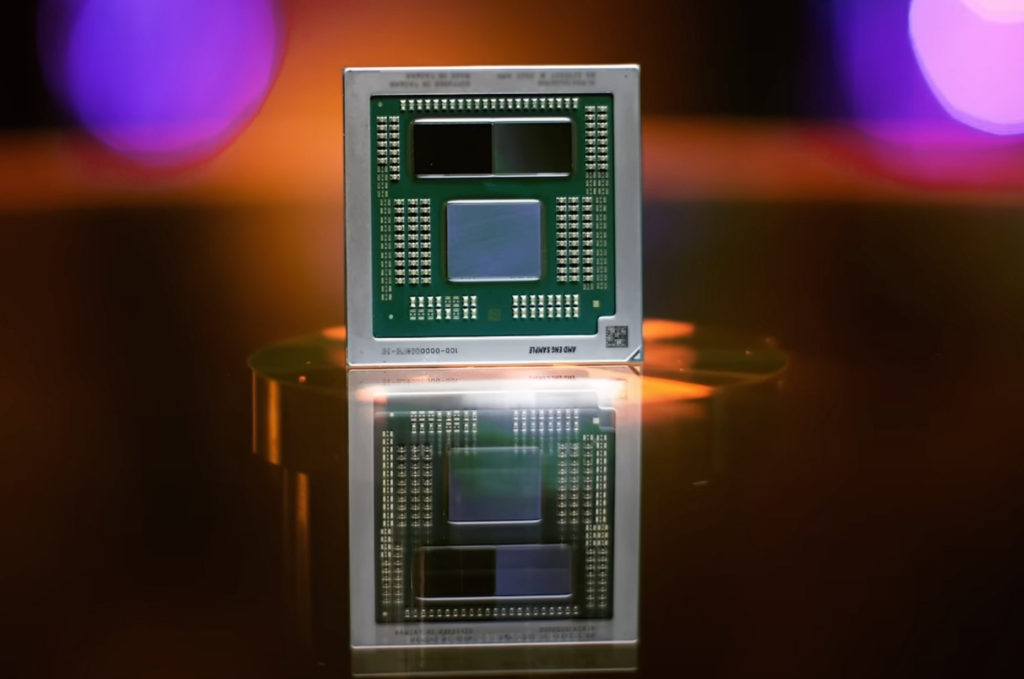
Key point: only one of them!
This means the CCDs are not equal — one ends up with 96 MB (32+64), while the other stays at 32 MB. Total: 128 MB of L3 cache.
And since each of the 16 cores also has its own 1 MB of L2, marketers love to cite a “grand total” of 144 MB of cache — though that’s mostly nominal.
Some applications — and especially games — love huge cache sizes. That’s why the Ryzen 9 9950X3D is rightfully considered the king of gaming performance.
Just like the Ryzen 7 9800X3D, by the way! Most games simply don’t need more than eight cores, especially when those cores are backed by massive cache.
Apparently, AMD has mastered the art of stacking 3D V-Cache onto CCD dies so well that in the new Ryzen 9 9950X3D2, both CCDs are expected to feature it.
That results in 96 + 96 MB of L3 = 192 MB total.
| Model | Cores / Threads | Base Clock | Boost Clock | L2 Cache | L3 Cache | Total Cache | TDP | Notes |
|---|---|---|---|---|---|---|---|---|
| Ryzen 5 9600 | 6 / 12 | 3.9 GHz | 5.2 GHz | 6 MB | 32 MB | 38 MB | 65 W | Standard non-X |
| Ryzen 7 9700X | 8 / 16 | 3.8 GHz | 5.5 GHz | 8 MB | 32 MB | 40 MB | 65 W | Low-TDP 8-core |
| Ryzen 7 9800X | 8 / 16 | 4.2 GHz | 5.7 GHz | 8 MB | 64 MB | 72 MB | 120 W | Boost-oriented |
| Ryzen 9 9900X | 12 / 24 | 4.4 GHz | 5.6 GHz | 12 MB | 64 MB | 76 MB | 120 W | 12-core high perf |
| Ryzen 9 9950X | 16 / 32 | 4.3 GHz | 5.7 GHz | 16 MB | 64 MB | 80 MB | 170 W | Standard 16-core |
| Ryzen 9 9950X3D | 16 / 32 | 4.3 GHz | 5.7 GHz | 16 MB | 128 MB (96+32) | 144 MB | 170 W | 3D V-Cache (1 CCD) |
| Ryzen 9 9950X3D2 | 16 / 32 | 4.5 GHz | 6.0 GHz | 16 MB | 192 MB (double 3D-V-Cache) | 208 MB | 200 W | NEW model |
Add the aforementioned 16 MB of L2, and marketers will happily claim a grand total of 208 MB. ))
However, it’s worth noting that many productivity workloads — like rendering — gain only about +5–7% from doubled cache. Sometimes they gain nothing at all.
These tasks prefer more cores, not more cache.
But in games, doubling the cache can boost FPS by up to 30%. Even so, the best price-to-performance pick remains the Ryzen 7 9800X3D.
It reaches higher clocks thanks to having only one CCD, runs cooler, and is easier to overclock.
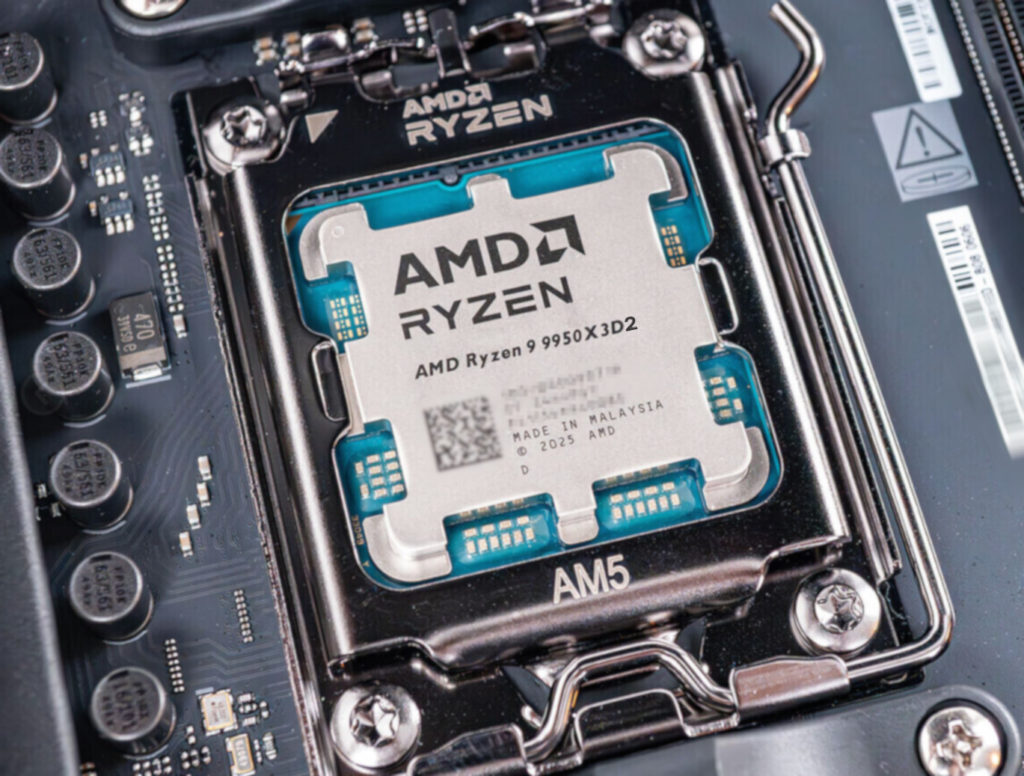
Naturally, heat will go up — increased specs push the TDP to 200W. And we all know that, in practice, it will be even higher.
So your motherboard must be ready, with a strong VRM design — at least 8 power phases — and hefty MOSFET heatsinks.
Conclusion
If the rumored specs of the Ryzen 9 9950X3D2 turn out to be true, it will undoubtedly be the most powerful desktop CPU on the market.
But its positioning is somewhat ambiguous: cache is for gaming, high core counts are for work… and needing both at the same time is rare.
But if it comes at the same price — then why not?


 Russian
  English