

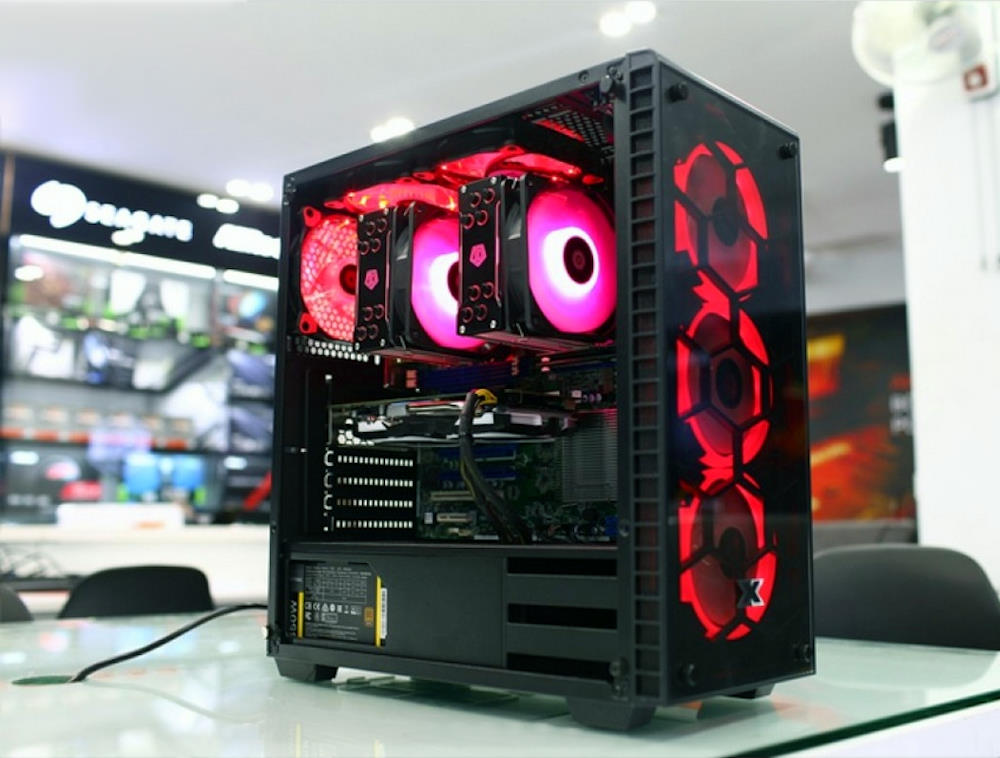
This article presents the key characteristics of popular 120 mm fans.
The data provided is generalized and does not refer to any specific model.
120mm fan speq table below.
| Power (W) | Voltage (V) | Current (A) | Speed (RPM) | Airflow (CFM) | Noise (dB) |
|---|---|---|---|---|---|
| 1 | 12 | 0.08 | 800 | 20 | 18 |
| 2 | 12 | 0.17 | 1200 | 30 | 22 |
| 3 | 12 | 0.25 | 1500 | 40 | 25 |
| 4 | 12 | 0.33 | 1800 | 50–55 | 28–30 |
| 5 | 12 | 0.42 | 2000–2200 | 60–70 | 32–35 |
| 6 | 12 | 0.50 | 2400–2500 | 75–80 | 38–40 |
| 9 | 12 | 0.75 | 2700–2800 | 90–95 | 42–44 |
| 12 | 12 | 1.0 | 3000–3200 | 100–110 | 45–48 |
| 18 | 12 | 1.5 | 3500–3600 | 120–130 | 50–55 |
Notes / Remarks:
- Airflow increases almost linearly with RPM at low speeds, but efficiency drops at high RPM due to turbulence and resistance from radiators/cases.
- Power grows roughly with the square of RPM. For example, doubling airflow requires much more than doubling RPM.
- Noise increases faster than airflow — doubling CFM often results in 2–3 times higher noise levels.
IMPORTANT: if you need to force air through tight radiator fins under pressure, fans with curved blades should be chosen.
If airflow volume is the priority (for example, case ventilation), a straight-blade impeller is more suitable.
It is important to understand that the listed values are approximate and may vary by ±10%. This depends on blade design and air temperature.
Also keep in mind that noise levels are highly subjective.
A pleasant bonus of 120 mm fans is that, despite their ability to generate noise, it is noticeably less aggressive and irritating than that of 80 mm or 90 mm coolers.
First, at equal power they operate at much lower speed. Second, the sound is a soft, low rustle rather than the long, high-pitched wail of a wounded banshee.
Also remember that not only the number and quality of fans matter, but where and in what order they are installed.
All of this is taken into account when I calculate cooling for a desktop system.



 English
  Russian