

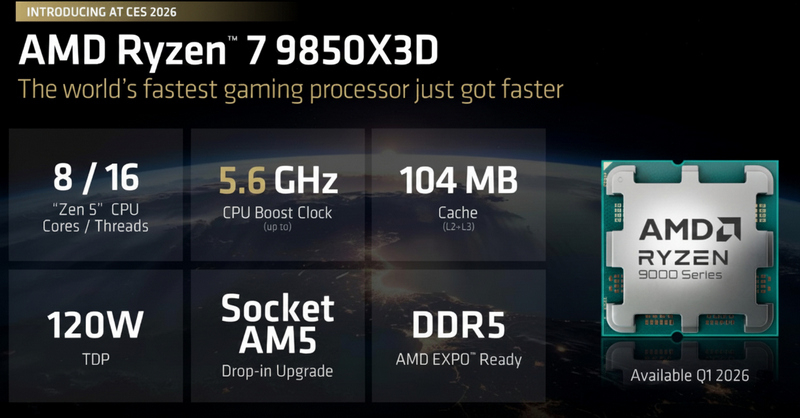
The new Ryzen 7 9850X3D, showcased at CES 2026, is presented by AMD as an evolutionary step forward, claiming the title of the “fastest processor” has become even faster. This chip is positioned as a refined version of the current gaming champion, the Ryzen 7 9800X3D. It builds upon the same foundational architecture, retaining the Zen 5 core design, 16 threads, and the crucial 64 MB of 3D V-Cache stacked on top of one compute die. This combination results in a massive total L3 cache pool of 96 MB, a key factor behind the exceptional gaming performance of the X3D series.
The primary upgrade in the 9850X3D is its peak boost clock frequency, which now reaches 5.6 GHz. This represents a 400 MHz increase over its predecessor, suggesting AMD has made subtle improvements to the silicon’s binning or the 3D packaging technology to allow for higher frequencies without compromising stability. Notably, the base clock speed and the Thermal Design Power (TDP) are reported to remain unchanged, indicating that this performance bump is achieved within the same power and thermal envelope.
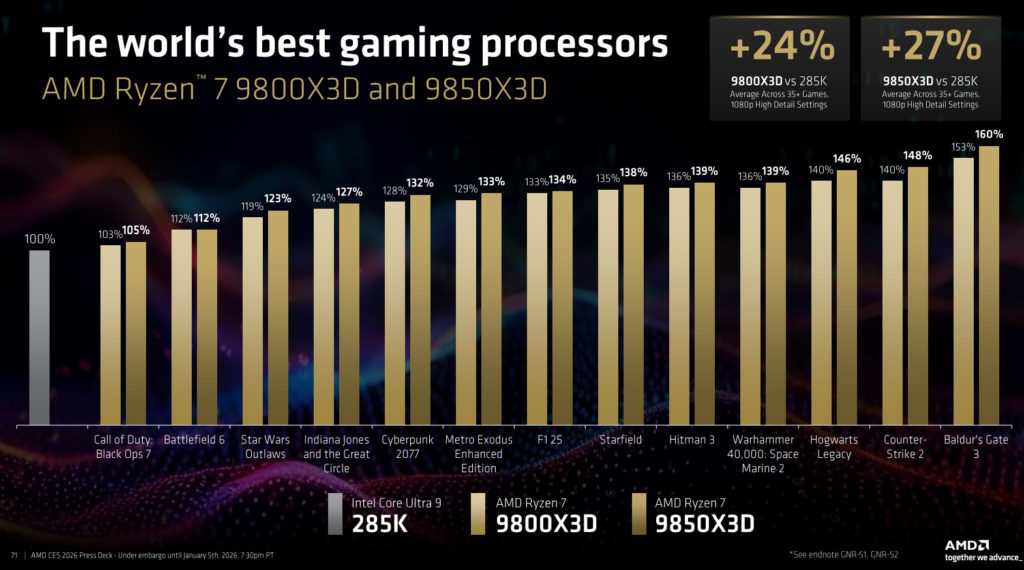
However, this release raises questions about its practical necessity. The performance delta, while present, appears incremental rather than revolutionary. AMD’s own comparisons pit the 9800X3D and the new 9850X3D against Intel’s flagship Core Ultra 9 285K, claiming gaming performance leads of 24% and 27%, respectively. This suggests the newer model offers only a single-digit percentage gain over the already dominant 9800X3D. For most users, such a minor improvement may not justify an upgrade, making this processor a targeted product for enthusiasts seeking the absolute peak performance regardless of cost.
Official pricing and a precise launch date remain unannounced. Industry speculation points to a release within the first quarter of this year. Its market success will likely depend heavily on its final price point relative to the still-formidable 9800X3D and the competitive response from Intel’s upcoming offerings.


 English
  Russian